Under construction, particularly the section on Benefits of Sleep
Contents:
PART 1 Basics
- Benefits of sleep: Rewards of a good night’s sleep and costs of decreased quantity or quality of sleep
- Biology of sleep: Stages of sleep, Regulatory systems of Circadian Rhythm and Homeostasis
- Sleep problems: Insomnia & Obstructive Sleep Apnea
Part 2 Recommendations
- How much sleep do I need?
- How do I create an optimal sleep environment?
- What habits should I cultivate to maximize the probability that I get the quantity and quality of sleep I need?
PART 1 Basics
Benefits of sleep
Rewards of a good night’s sleep:
1.Cognitive & neurological benefits:
- Better concentration & focus [1]
- Clearer thinking [1] [2]
- Improved decision making ODPHP
- Improved productivity at work and school [1] [2]
- Have greater capacity to learn new information after a good night’s sleep [2]
- What you have learned during the day gets consolidated in memory in a good night’s sleep [2]
- Creative problem solving is enhanced after a good night’s sleep
- Glimphatic system clears out accumulated toxins, plaques, and tangles from your brain, lowering your risk of Alzheimer’s
- Quicker reflexes [1]
2.Immune system benefits
- Get sick less often ODPHP
3. Cardiovascular and metabolic benefits:
- Stay at a healthy weight
4. Benefits for Mood & Social interactions
- Reduce stress and improve your mood
- Get along better with people
5. Avoid accidents
Immediate & short-term costs of shortened or interrupted sleep
1.Cognitive & neurological costs:
- “Impairs higher levels of reasoning, problem-solving, and attention to detail” [1]
- Impaired performance and increased errors oup art 38
- Makes it harder to focus (even after cutting back just 1 hour) [2]
- “More likely to make bad decisions and take risks” [2]
- Slower response time
2.Higher risk of accidents oup art 38 including traffic accidents [1]
Due to slower reflexes, greater likelihood of taking risks, possibility of falling asleep while driving
3.Less productive at work [1] [2]school [2]
4.Negative impact on mood, which can have a negative influence on social interactions [1]
Long-term costs of shortened or interrupted sleep
1.Increased risk of depression
2.Negative impact on metabolic and cardiovascular factors
- Obesity [1] [2]
- Hypertension [2]
- Heart disease [2]
- Stroke Acad oup art 38
- Diabetes [2]
- All cause mortality oup art 38
3.Negative impact on immune system
- Impaired immune function oup art 38
- Reaction to vaccines is significantly less robust following a week of poor sleep [1]
4.Increased perception of pain
oup art 38 Above
Sort out: partial sleep restriction demonstrated impaired glucose tolerance, higher evening cortisol levels, alterations in sympathetic nervous system activity, reduced leptin levels (a hormone that regulates satiety), and increased levels of ghrelin (a hormone that regulates hunger).41,42 Increases in inflammatory markers such as C-reactive protein, tumor necrosis factor (TNF)-α, and interleukin (IL)-6 have also been associated with short sleep. Oup 35
Biology of Sleep
Stages of sleep
There are two basic kinds of sleep: REM (Rapid Eye Movement) and non-REM (which scientists refer to as NREM)
- Stage 1: Very light NREM; you might believe you weren’t actually sleeping if awakened in this stage
- Stage 2: Light NREM
- Stage 3: Deep NREM
- Stage 4: REM (usually starts about 90 min into the sleep cycle)
During a good night’s sleep, you will cycle through these 4 stages in 4-6 sleep cycles
Two body processes that influence sleep:
1. Circadian rhythm
This internal daily rhythm is intrinsic but is affected by the environment, primarily by light and darkness. It also impacts body temperature and the secretion of melatonin and cortisol. [3]
2. Homeostatic process
The homeostatic process acts in a way that is complementary to the circadian rhythm. Your brain monitors the time elapsed since you last slept. The longer it’s been since you were last asleep, the greater the pressure of the “sleep drive”—that is, your brain manifesting its desire for more sleep. In the case of “sleep debt” from a short term sleep deprivation, this regulating mechanism will work to make up that debt by shortening the time it takes you to go to sleep and then lengthening the total sleep time. In the case of longer term sleep deprivation, your brain will overwhelm your active efforts to stay awake, resulting in 3-30 sec “microsleeps” when the you may not even be aware that you’ve fallen briefly asleep. If you are behind the wheel of a car when this happens, tragedy can obviously follow. [3]
Sleep problems:
Material in this section is from Barbell Medicine Podcast with Nate Gordon, MD (family medicine doctor and sleep specialist) unless otherwise specified [6]
Insomnia
According to Nate Gordon, MD (family medicine doctor and sleep specialist)
Insomnia is defined as difficulty initiating and/or maintaining sleep [6]
There are two categories of insomnia:
Acute insomnia
- Occurs 3 or more nights per week and has lasted less than 3 months
- Acute insomnia may be able to be taken care of by following recommendations for better quantity and quality of sleep [section following Obstructive Sleep Apnea]
- If the recommendations don’t help, it’s important to seek treatment before getting to the 3 month mark
Chronic insomnia
- Has lasted 3 months or more. It’s important to get treatment, preferably before it gets to this point.
- The first line of treatment is not typically medication but rather Cognitive Behavior Therapy for Insomnia (CBT-I) CBT-I is often needed for 6-8 weeks
According to the American Academy of Sleep Medicine: “Initial approaches to treatment should include at least one behavioral intervention such as stimulus control therapy or relaxation therapy, or the combination of cognitive therapy, stimulus control therapy, sleep restriction therapy with or without relaxation therapy—otherwise known as cognitive behavioral therapy for insomnia (CBT-I)” [7] More specific information including recommended pharmacological agents can be found at the link.
Self-report instruments for the assessment of insomnia:
Many of us get used to our own sleep patterns even if they are problematic. Others of us wonder if it’s really something to see a health care practioner about. Here are two self-report measures that may help chrystalize issue for you.
The Pittsburgh Sleep Quality Index PSQI is one self-report instrument used to assess insomnia. PSQI
A global score of 5 or higher is indicative of poor sleep quality. [10]
Another is the Insomnia Severity Index
See a health care practioner if you have any concerns.
Obstructive Sleep Apnea
Obstructive Sleep Apnea (OSA) must be diagnosed and treated by a physician.
An acronym to give an idea of the likelihood that you have obstructive sleep apnea is :
STOP-BANG
STOP is an acronym for symptoms; BANG is an acronymn for risk factors
S-snoring
T-tired during the day
O-Observation of a pattern in which you stop breathing at night by your sleeping partner
P-Pressure—Do you have high blood pressure?
Answering yes to 2/4 of the symptoms above raises the suspicion of obstructive sleep apnea
B- BMI over 35
A- Age over 50
N-Neck circumference > 17 for a man, >16 for a woman
G–Gender -males are more likely to have OSA than women (until menopause)
To read about treatment of OSA :
American Academy of Sleep Medicine : Treatment of OSA of Adults with Positive Airway Pressure
Part 2 Sleep recommendations
How much sleep do I need?
Recommendations for the general population:
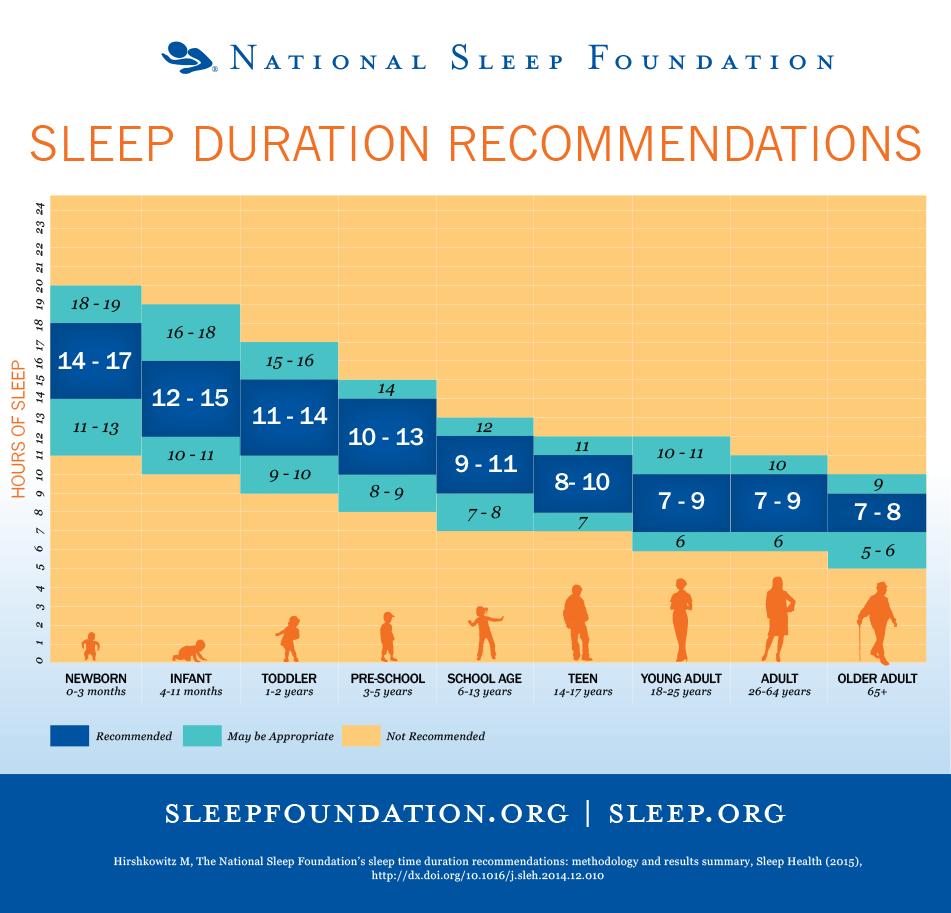
Most adults in the 18-24 range will thrive on 7-9 hours sleep; fewer can do well on as little as 6 hours sleep and some need as much as 10-11 hours sleep. Not recommended: Less than 6 or more than 11 hours sleep.
Most adults in the 25-64 age range will thrive on 7-9 hours sleep; fewer can do well on as little as 6 hours sleep and some need as much as 10 hours sleep. Not recommended: Less than 6 and more than 10 hours sleep
Most adults 65 and older will thrive on 7-8 hours sleep. Fewer can do well on as little as 5-6 hours sleep and some need 9 hours sleep. Not recommended: Less than 5 or more than 9 hours. [5]
The amounts of sleep recommended for the general population (above) is not necessarily the amount that is best for an individual.
How do I know which amount is right for me as an individual?
“It is the amount of sleep that leaves you wide-awake, alert, in a great mood, and functioning at your best.” –Meir Kryger, MD (physician, professor at Yale and author of several textbooks on sleep for medical students, and has published over 200 research articles. ) [8]
If on the other hand, you feel tired during the day, need caffeine to get through the day, or fall asleep during the day, you need more sleep than you are getting.
Not sure how tired is “too tired”? The Epworth Sleepiness Scale can help you decide.
How do I create an optimal sleep environment?
- Comfortable mattress and pillows
- Cool room temperature (Max temperature should be somewhere between 67-70 degrees)
- Dark room: Make sure the room will stay dark during the night until you actually want to get up. You can use room darkening curtains or blinds or sleep masks to accomplish this.
- Quiet room: Ear plugs or a white noise machine or app may be helpful if you live in a noisy environment or your sleep partner snores. A snoring sleep partner may also necessitate separate rooms to ensure a good night’s sleep. Dr. Kryger notes that “Ear plugs sold for industrial use can be less expensive and may be more effective” than others. [9] p.81
What habits should I cultivate (or eliminate) to improve the quantity and quality of my sleep?
Sleep stealers: Habits that sabotage sleep
Avoid putting these sleep stealers into your body:
- Smoking before bed: Many smokers like to have cigarette right before bed, but cigarette smoke is a stimulant and can interfere with your sleep
- Alcohol before bed: alcohol is a sedative and you may feel that it puts you to sleep faster, but it disrupts the quality of your sleep
- Caffeine: Caffeine has a half life of 8 hours, which means that half the caffeine you ingested is still affecting your system 8 hours later. You may need to limit caffeine to hours before noon, depending on your bedtime.
- Foods that cause indigestion: if you are still digesting food when you lie down to go to sleep, any resulting indigestion can interfere with your sleep quality and quantity
Also pay attention to:
- Blue light from electronics: Smart phones, tablets, laptop, TV shuold be avoided in the hour or two before bed
- Over-stimulating or anxiety-producing information before bed
Sleep safeguards: Habits that give you the best chance of a good night’s sleep
1.Establish a consistent schedule
Go to bed at the same time each night and get up at the same time each morning, even on the weekends
2.Create a bedtime routine that prepares your body for sleep by relaxing you. Consider elements such as:
- Reduce the brightness of light in your home a couple hours before bedtime
- Take a warm bath or shower : it’s relaxing and your body temp will drop afterward, cueing sleep
- Avoid sleep stealers: caffeine, alcohol, nicotine, food that might cause indigestion
- Trade your blue-light emitting devices for reading a real book, writing in your journal, etc. (Select any reading material carefully. You don’t want something that you can’t put down when you begin to feel sleepy)
3. Wake-up/Daytime routine is critical too:
- Expose yourself to natural light as soon as possible after waking. According to Nate Gordon, MD, this may be the most important thing you can do. [6] This will reset your circadian rhythm if it’s been off and maintain it to keep your sleep/wake times consistent.
- Open the blinds & curtains in the house and sit near a window while you drink your coffee or eat breakfast
- Better yet, if at all possible, go outside for a few minutes. If you have a balconey or patio, eat breakfast or drink your coffee there, work in a few minutes of prayer or meditation, throw in some stretching or yoga, or jot down your to-list for the day.
- Limit naps to no more than 20 min. ODPHP
- Stop drinking caffeine relatively early in the day (It has a half life of 8 hours, meaning 8 hours after the last cup, 1/2 of the caffeine dose is still acting on your system.)
- Exercise daily Even a small amount of exercise has a positive impact on sleep that very night. However, intense exercise very close to bedtime can negatively impact some individuals.
Sources
[1] NIH News in Health April 2013 [2] NIH Your Guide to Healthy Sleep [3] Journal article: Sleep June 2012 [5] 2015 Sleep Duration Recommendations from National Sleep FoundationPDF of 2015 Sleep Duration Recommendations from National Sleep Foundation
[6] Podcast with Feigenbaum, Baraki, Gordon [7] American Academy of Sleep Medicine standards for treatment of insomnia [8] Meir Kryger, MD [9] The Mystery of Sleep. Meir Kryger, M.D . Yale University Press. 2017. [10] Pittsburg Sleep Quality Index