If you are concerned about your risk of Alzheimer’s and other dementias, there is increasingly good news–not yet from medications— but in terms of choices you have control over that can lower your risk! And that reduced risk applies even if you have genetic risk factors!
It’s never too early–nor too late!
Not one, but three different researchers on prevention of dementia have said that! Martha Clare Morris of Rush University [7] and Gill Livingston and Naaheed Mukadam of the Lancet Commission [8]
Simultaneously addressing clusters of lifestyle choices appears especially effective:
The FINGER study out of Finland
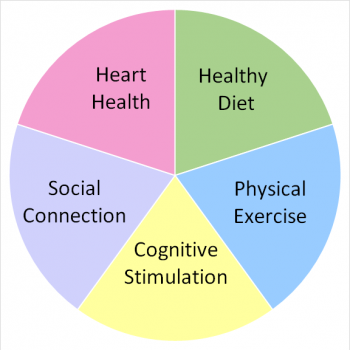
Unless otherwise indicated, information in this study about the FINGER study is from source [1]
FINGER: The Finnish Geriatric Intervention Study to Prevent Cognitive Impairment and Disability
Results: Participants in the experimental part of the trial (who received intensive support to improve these factors) had a 30% risk reduction in cognitive decline compared to the control group (who only received advice about what to change.) These behavior choices seemed to have an even stronger effect on risk-reduction in those with a higher genetic risk [having the the ApoE-4 gene] than others. [3]
Type of study: This was a randomized, controlled trial or RCT . RCTs are considered the gold standard in research because they allow researchers to draw conclusions about causality, not just association or correlation. There have been many observational studies that showed associations between these factors and dementia. This is the first RCT that showed that improving these factors actually prevented risk. It showed cause and effect, not just association.
Length of study: 2 years for the initial intervention. Follow up is on-going.
Participants: 1260 older adults aged 60-77 years with increased risk of dementia
Cluster of behavior patterns:
- Physical exercise (Aerobic, muscle-strengthening, balance. The aerobic exercise was chosen by the participants and done on their own; muscle-strengthening and balance exercises were done in a supervised setting.) [2]
- Adherence to a healthy diet (Prudent Nordic diet) & weight loss if deemed needed [2]
- Cognitive training/intellectual stimulation through computer training individualized to each participant*[2]
- Social connection (arranged in combination with the computerized cognitive training & other group counseling and coaching sessions*) [2]
- Intensive monitoring and management of heart & metabolic health (After specific cardiovascular factors were evaluated by the study physician, participants met with a nurse every 3 months the first year and every 6 months the second year and received basic monitoring of blood pressure, weight, and body measurements as well as supportive counseling for making needed changes.) [2]
*Note: The study itself combines the cognitive stimulation and social connection into one variable. I thought it made more sense to separate them out for the purposes of individuals who are looking at habits they can change to reduce their risk.
Update: I was pleased to hear the lead researcher on the FINGER study say that it really could be called 5 fingers, and she also mentioned that the social connection component could be separated out. [5]
I can see how I can make changes in most of these areas, but if the computerized training program was only available to the participants, how does that help me?
One of the primary researchers, Miia Kivapelto, MD addressed this issue in an interview: ” I don’t think we can say that there’s one type of cognitive training [that works] or one miracle case. I think we need to have tasks that are challenging enough so that we can see an effect. … any kind of brain training [can be effective]. It can be learning a new language or reading a book or having complex work where you need to use the brain but I think we have a quite a lot of evidence that using the brain and having challenging tasks is good.” [3] These types of everyday activities were similar to those measured in the Rush 2020 study below.
Additionally, studies attempting to replicate the FINGER study are taking place in several countries around the world. Each will contextualize the study for their own culture. Four of those studies: the US, Australia, Ireland, and Japan –will be using a commercially available cognitive training program called Brain HQ by Posit Science. They will be using the following subtests: Freeze Frame, Hawk Eye, Visual Sweeps, Target Tracker, Minds Eye, Double Decision, Mixed Signals, Juggle Factor, Divided Attention,. Eye for Detail, Right Turn, Scene Crasher, & Mind Bender. Ireland, Australia, and Japan will also be using Card Shark . [6]
Next steps:
Trials of the FINGER study, contextualized for each culture, are currently being conducted around the world, including the US, Canada, Australia, Europe, China, Singapore, Japan, India, and Latin America. The US trial is called the POINTER study : study to Protect Brain Health through Lifestyle Intervention to Reduce Risk. Results were expected by 2021. [1] Covid will likely delay this.
A European trial called MIND AD has started with people with mild Alzheimer’s disease to see how these findings might apply to those already exhibiting symptoms. [3]
Another European trial EURO-FINGERS/MET- FINGER -APOE is being done using the lifestyle interventions from FINGER and then adding a drug, Metformin, which has shown some promise against cognitive decline on its own.
[1] Multidomain Interventions to Prevent Cognitive Impairment, Alzheimer’s Disease, and Dementia JPAD 20 [2] http://alzheimersprevention.org/downloadables/FINGER-study-report-by-ARPF.pdfThis material may be reproduced and shared, provided:
a. The ARPF is acknowledged and referenced at www.alzheimersprevention.org
b. You tell us about the venue where you shared it. Please email us at
kirti@alzheimersprevention.org.
Rush University Study June 2020
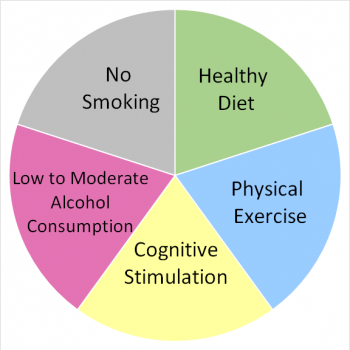
Results: People with 4 – 5 of these protective behavior patterns showed a 60% reduction in risk of Alzheimer’s compared to people with only 0-1 of these factors. People with 2-3 of these behaviors had a 37% reduction compared to people with 0-1 of these protective behavior choices.
The results held true even after controlling for cardiovascular health and genetic risk factors such as the ApoE-4 gene.
Type of study: The Rush study is a longterm observational study (which can show association or correlation but does not prove that the association is one in which the variables measured caused the outcome.)
Participants: 2765 participants
All participants were from either the long-standing CHAP or MAP studies on nutrition and cognition that had been being conducted at Rush. CHAP participants had been followed for 17 years and MAP participants had been followed for 14 years. [5]”During 14 [-17] years of follow-up, there were 379 (21%) and 229 (25%) incident cases of Alzheimer’s dementia in CHAP and MAP, respectively.” [4]
See the article on the MIND diet for more info on the CHAP and MAP studies.
The cluster of 5 behavior patterns included:
- Physical exercise : 150 min. or more of moderate to vigorous physical activity per week (1 pt. was assigned for people engaging in at least 150 min. per week; 0 pts. for people exercising less.)
- Adherence to items in the MIND diet (1 pt for people whose adherence was in the top 40%; 0 pts if less )
- Engagement in any of seven late life cognitive/intellectual activities such as reading, writing letters, visiting the library, or participation in games such as chess and checkers. (1 pt was assigened for people in the top 40%; 0 points if less) [4]
- Light to moderate use of alcohol (1 pt for women who drank up to 1 serving of alcohol or men up to 2 servings per day; 0 points for those who drank more)
- Not smoking (1 pt. for either never smoking or being a former smoker; 0 pts. for currently smoking)
“This population-based study helps paint the picture of how multiple factors are likely playing parts in Alzheimer’s disease risk,” said Dallas Anderson, Ph.D., program director in the Division of Neuroscience at NIA [National Institute on Aging] . “It’s not a clear cause and effect result, but a strong finding because of the dual data sets and combination of modifiable lifestyle factors that appear to lead to risk reduction.” [3]
Are there similarities between the Prudent Nordic Diet followed in the FINGER study and the MIND diet in the Rush study? Yes.
The Prudent Nordic Diet, MIND diet, and Mediterranean diets have some common elements:
” Among dietary patterns, cognitive benefits have been reported for different diets which are based on frequent consumption of
- Fruits and vegetables
- Unsaturated fats (olive oil in Meditteranean & MIND, rapeseed oil in FINGERS) ,
- Whole grain products
- Fish
As opposed to single nutrients, the role of healthy and balanced dietary patterns may be more relevant, because nutrients have cumulative and synergistic effects.” [1] [numbering added for emphasis]
Additionally, in the World Wide FINGERS trials, the MIND diet has been adopted for the “healthy diet” component by the US & Australian trials (with some tweaks for aspects particular to Australia.) [8]
Studying clusters of behaviors is a likely direction for future research:
Heather Snyder, director of medical and scientific operations at the Alzheimer’s Association, said “she expects to see more studies examinining the role of lifestyle choices going forward.
“I think we will see people honing in on, ‘What are the specific aspects of these behaviors that are already identified?’ ” she said. “But I also think we’ll see people asking, ‘What are other behaviors?’ ”
Snyder said she would not be surprised if the number of recommended lifestyle choices eventually rose as high as 10 or 12.” [6]
[1] https://www.ncbi.nlm.nih.gov/pmc/articles/PMC4863273/ [2] https://www.alzdiscovery.org/cognitive-vitality/blog/five-healthy-lifestyle-factors-associated-with-reduced-alzheimers-risk [3] https://www.nia.nih.gov/news/combination-healthy-lifestyle-traits-may-substantially-reduce-alzheimers-disease-risk [4] https://www.rushu.rush.edu/news/can-healthy-lifestyle-reduce-dementia-risk [5] https://www.alzdiscovery.org/cognitive-vitality/blog/five-healthy-lifestyle-factors-associated-with-reduced-alzheimers-risk [6] Washington Post: Doing these 5 things could reduce your risk of dementia by 60% [7] Morris, M. C. (2017). Diet for the Mind. NY, NY: Little, Brown, & Company. [8] Personal notes taken from presentations at the Alzheimer’s Association International Conference ® 2020 in the question and answer session following the presentations from the Lancet Commission. [9] Personal notes taken from presentations at the Alzheimer’s Association International Conference ® 2020 from the presentation on the Australian AU-Arrow FINGER trial.
