Ready to start self-coaching your way to reducing your risk of cognitive decline?
If you are unfamiliar with the I-SSEE method of self-coaching, it would be helpful to read through the Introduction to Self-Coaching in the Welcome section. Reading the expanded section for Identifying your most powerful motivations for change in the Motivation section would also be helpful if you haven’t read it before.
You will need to also read through Foundations I and Foundations II for reducing your risk of cognitive decline.
Because there are so many possible factors, I’m going to first summarize them in 2 pie charts and a table.
The pie chart on the left summarizes the FINGER study and the one on the right summarizes the Rush 2020 study. An * indicates this factor is also included in the report by the Lancet Commission.
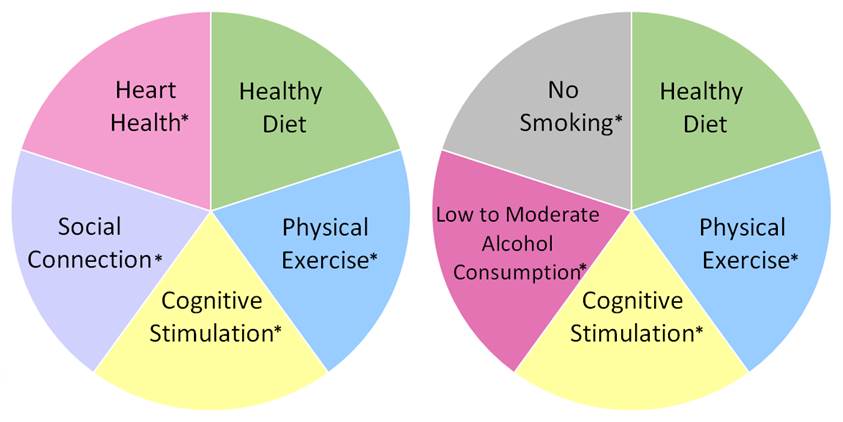
The rest of the factors included in the Lancet Commission’s recommendations or other studies could be grouped together under the heading: Be proactive about your medical care:
Becoming an educated, proactive health consumer is an important step to reducing your risk of dementia. Scheduling a visit to your primary care provider can enable you to address up to 9 risk factors for dementia in one visit!
| Factor(s) you may want to address with your primary care provider | Other resources |
| Check your heart health: blood pressure, cholesterol, and other cardiovascular disease or risk factors. | If you have issues with your blood pressure, consider getting a home blood pressure monitor |
| Check your metabolic risk factors: Diabetes, prediabetes, elevated glucose, low HDL, elevated waist circumference, high blood pressure, high triglycerides, etc. | If you’re prediabetic, consider getting a home blood sugar monitor |
| Obesity | |
| Check to make sure none of the drugs you are taking could be increasing your risk of dementia & discuss substitutes if needed | American Geriatrics Society 2019 Updated AGS Beers Criteria® for Potentially Inappropriate Medication Use in Older Adults |
| Get help to quit smoking | Tips and resources from the CDC
Tips and suggested plan of action from American Cancer Society |
| Sleep apnea, insomnia: Getting a referral for a sleep study or to a physician who is also a sleep specialist | Find a sleep facility near you |
| Get help to stop excess drinking | |
| Get a hearing screening. If necessary, get a referral to an ENT and make hearing aids a top priority for any hearing loss | If you are a member of AARP, they have a free hearing screening you can do over the phone |
| Keep up with your flu and pneumonia vaccines |
Two more appointments and you’ve got your bases covered!
| To protect your vision and treat any vision problems: Schedule an appointment with your ophthalmologist or optometrist for an eye exam and follow up with exams on the recommended schedule. | |
| To take care of your gum health: Schedule an appointment with your dentist to address gum health and follow up with appointments on the recommended schedule. |
Ready to get started using the I-SSEE method to reduce your risk of cognitive decline?
Though working on several factors at once may seem a bit overwhelming at first, you’ll find they are typically interconnected, so what you do to improve in one area may make it easier to improve in others.
For example, you might have high blood pressure and your doctor may suggest you make some lifestyle changes. She or he might recommend including more fruits and vegetables in your diet, losing about 5% of your bodyweight, and increasing your physical activity.
Or you might go to the doctor to have sleep apnea evaluated. Once it’s treated, you may find your hunger goes down (hunger hormones are affected by too little sleep) and you may have more energy to add more physical activity.
Let’s first think through the first portion of Step 1 Identify as it might apply to reducing your risk of cognitive decline. Then you can go to specific portions of Reset& Renew to chart your course for a reduced risk of cognitive decline.
Step 1 :I-Identify:
Identify your overall goals:
Examples of overall goals:
- I want to reduce my risk of cognitive decline by improving my eating, getting more exercise, and scheduling an appointment with my primary caregiver to ask for help to stop smoking.
- I want to reduce my risk of cognitive decline by taking steps to be more physically active, adding more cognitively engaging activities to my life, and taking initiative to increase my social connections.
- I want to reduce my risk of cognitive decline by making an appointment at a sleep clinic to see if I have sleep apnea and I also want to make an effort to strengthen my social connections.
Identify any reasons that you are reluctant to change:
Examples:
- I love hamburgers and fries at my favorite fast food restaurant and besides, it’s convenient.
- I’m afraid that if I give up smoking, I’ll gain weight.
- I don’t want to give up my TV time for exercise or more cognitively stimulating activities.
- Thinking about the possibility of cognitive decline makes me so anxious, I’d rather just stick my head in the sand.
After you’ve been honest with yourself about reasons you are reluctant to change, evaluate them to determine how realistic they are. If they are realistic, ask yourself whether there is anything you can do to address the fear or minimize the loss.
Identify your deepest, most powerful reasons for making these changes
“I want to avoid cognitive decline” is a pretty powerful motivation, but motivations that involve gaining something, not avoiding something, tend to be more powerful still:
- “I want to be able to remember my loved ones and continue making and sharing memories all my life.”
- “I want to be able to get together with friends and play bridge.”
- “I want to be able to continue to contribute to my community.”
- “I want to be able to live independently in my home.”
Imagine how your life and your interaction with your loved ones and ability to do the things you now enjoy will be impacted if you stay mentally sharp versus if you decline cognitively. Though it’s hard to think about the impact of cognitive decline, change is hard, too. There will be times when you need to remember these deepest motivations in order to move forward with change.
If it is a choice between “Get on the stationary bike and pedal while watching my show” vs. “Stay on the comfy couch while watching this show,” you will likely need the extra boost of motivation in which you say to yourself: “I can watch my show while riding the bike and give myself my best shot of sharing memories with my children and grandchildren. ”
From this point, the content of the I-SSEE steps may diverge a bit depending on the specific cluster of risk factors you have chosen to improve:
Several potential paths to reducing your risk are included in specific subject areas on Reset & Renew.
- Eating a healthy diet : Are you intrigued by the research on the MIND diet for reducing your cognitive risk? Go to the Foundations MIND diet to learn more about specifics and then to Self-coaching for the MIND diet to develop your own plan.
- Being physically active: Do you have a feeling you would be better off with more physical activity? To evaluate whether you need to improve your levels of physical activity and how, go to the Fitness category and start with Fitness Foundations and then choose the Fitness Self-coaching article that is right for you. (There is one for adults in general and one for older adults)
- Maintaining or attaining a healthy weight: Do you need useful information to plan a course for losing or maintaining weight? Go to Managing Weight Perspectives, Foundations, and Self-coaching. (Links not ready yet)
- Getting quality sleep: Do you wonder if your sleep quality is affecting your life and your risk of cognitive decline? Sleep Foundations will give you some basic information to get started, then you can move on to Self Coaching to get the sleep you want and need .
- Increasing your levels of cognitive engagement & strengthening social connections (link not ready)
- Proactively managing medical needs (link not ready)
